
2017 · San Francisco International Art Festival · Fort Mason Chapel
Ancient tragedy staged in a chapel at Fort Mason. A liminal space between the sacred and the profane. Theater Bay Area Award.
Classical, modern, avant-garde — the beautiful and the deliberately ugly. All part of the same conversation.
You don’t choose this life. It chooses you. Usually early, and without asking permission.
At ten years old, I’m standing on a stage in a West Coast Beckett Festival production of Waiting for Godot, directed by Alan Schneider himself, cast as the Boy by my father, Charles R. Lyons. Most kids that age are playing Little League. I’m learning that silence has weight, that stillness is a choice, that waiting is the action.
But it started even earlier.
I’m five, maybe six years old, sitting next to my father at a matinee, Pinter or Stoppard, something dense and adult. I’m wearing a blazer, dressed better than I do for church, and I don’t understand why. So I ask him.
“Why do I have to wear this? I’m more dressed up than for church.” He doesn’t miss a beat. “This is more important than church.”
That’s when you learn what matters. What’s sacred. Not the building with the steeple, but the room where people gather to bear witness to the truth of being alive, messy, brutal, beautiful, inexplicable.
My father dragged me around the world to see theater. Not to museums, not to tourist traps — to theater. Classical, modern, avant-garde, contemporary, the beautiful and the deliberately ugly. He taught me that it’s all part of the same conversation, the same hunger to make sense of being human by putting bodies in a room and asking them to transform.
Sam Shepard used to show up at our house to talk with my dad. Between their sessions, he’d step out back to chain-smoke, and somehow, I was worth talking to. By then, I’d started writing as a young teenager, badly, but with the kind of conviction only adolescence allows. Playwriting seemed like something special, powerful, romantic. The idea that you could write truth so raw it made you dangerous, so beautiful it made you irresistible… I bought into all of it.
Years later, I’m just sixteen, and for reasons I still don’t fully understand, my father gives me his tickets to opening night of A Lie of the Mind at ACT in San Francisco and lets me drive to the city alone. First intermission, I run into Shepard. We walk across the street to Jack in the Box. The conversation is good enough that we meet back there during the second intermission. A sixteen-year-old kid and one of American theater’s greatest playwrights, eating fast food burgers and talking about the work. That’s when you learn: genius doesn’t require white tablecloths. And sometimes, the best education happens when someone hands you the keys and trusts you to just show up.
Directing isn’t about control. It’s about listening so deeply you can hear what wants to be born. It’s about creating the space where accidents become revelations.
At Stanford, I get to work with Anna Deavere Smith on Twilight at the Mark Taper Forum. Watching her conjure three dozen souls through a single body, building a city from voices — that’s its own education in what directing can be.
Then Lee Breuer takes me on the road. I start as a Production Assistant, the grunt, the nobody. Slowly, I become Technical Director, then Production Manager, then Producer. Years of this, learning in real time that the job isn’t about vision in the abstract. It’s about making the vision happen, with duct tape, diplomacy, charm, and sheer will. Eventually, we end up co-teaching a class at Stanford called the Actor/Director. Full circle, but not really. In this work, there are no circles. Only spirals.
These people taught me that directing isn’t about control. It’s about listening so deeply you can hear what wants to be born. It’s about creating the space where accidents become revelations. It’s about knowing when to push and when to get the hell out of the way.
What follows are the projects where I tried, sometimes succeeding, often failing, to honor what they taught me.
Productions
Directing & Producing
Ancient tragedy staged in a chapel at Fort Mason. A liminal space between the sacred and the profane. Theater Bay Area Award.
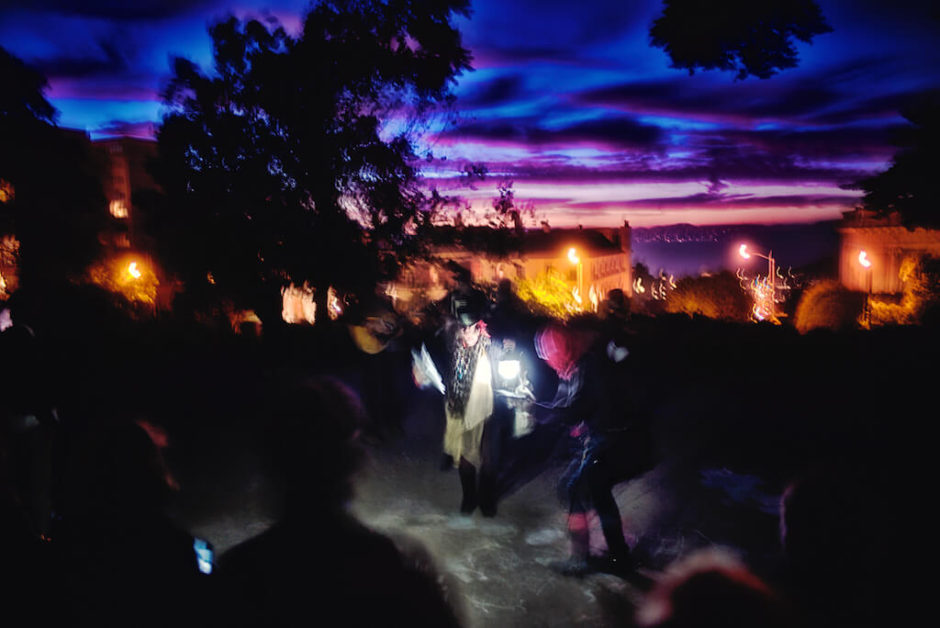
Free Shakespeare in the Presidio with the San Francisco Shakespeare Festival.

Genet’s hallucinatory vision of power and performance staged in the vaults of the Old Mint. Collected Works.

Site-integrated performance in the abandoned batteries of the Marin Headlands with We Players.

Hare’s adaptation of Schnitzler’s La Ronde at Stanford.

Shepard’s mythic sibling warfare. Two brothers, one typewriter, a kitchen full of toast.

The persecution and assassination of Jean-Paul Marat as performed by the inmates of the Asylum of Charenton under the direction of the Marquis de Sade.

Jacobean revenge tragedy. Skulls, poison, and the kind of moral rot that never goes out of style.

Pinter’s brutal compression of state violence and the politics of silence.
‘During the war, when I had a great deal of time to think, and no friends to amuse me, I conceived of a new kind of drama. One in which the conventional separation between actors and audience abolished. In which the conventional scenic geography, the notions of the proscenium, stage, auditorium, were completely discarded.’John Fowles — The Magus, 1966