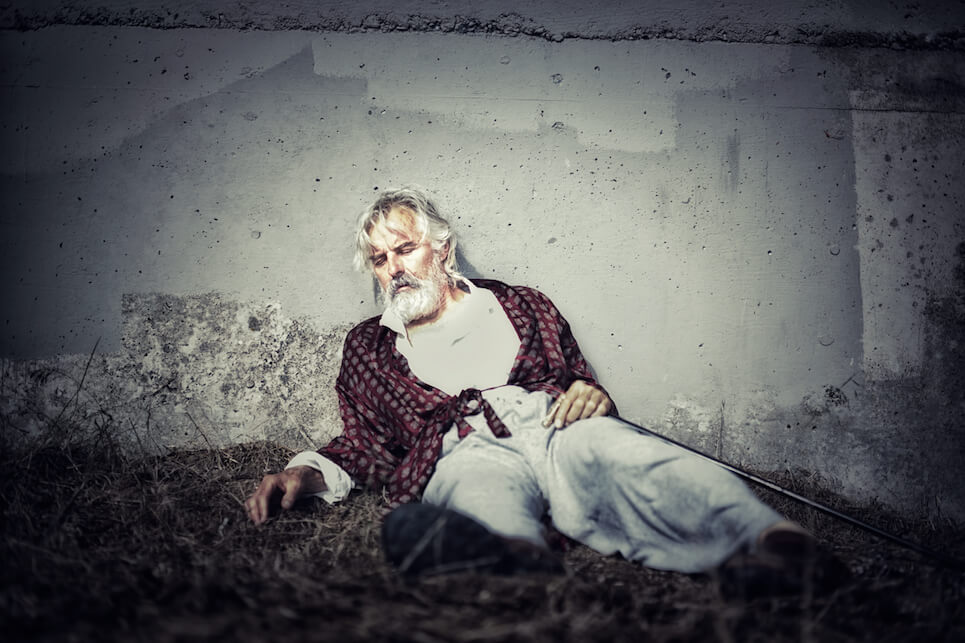
Three productions. One summer. 2014. Three sites that had nothing in common except that for a few hours each, on a few nights each, they became King Lear. King Lear, of all things. The biggest play. The one nobody should attempt. The one everybody attempts anyway.
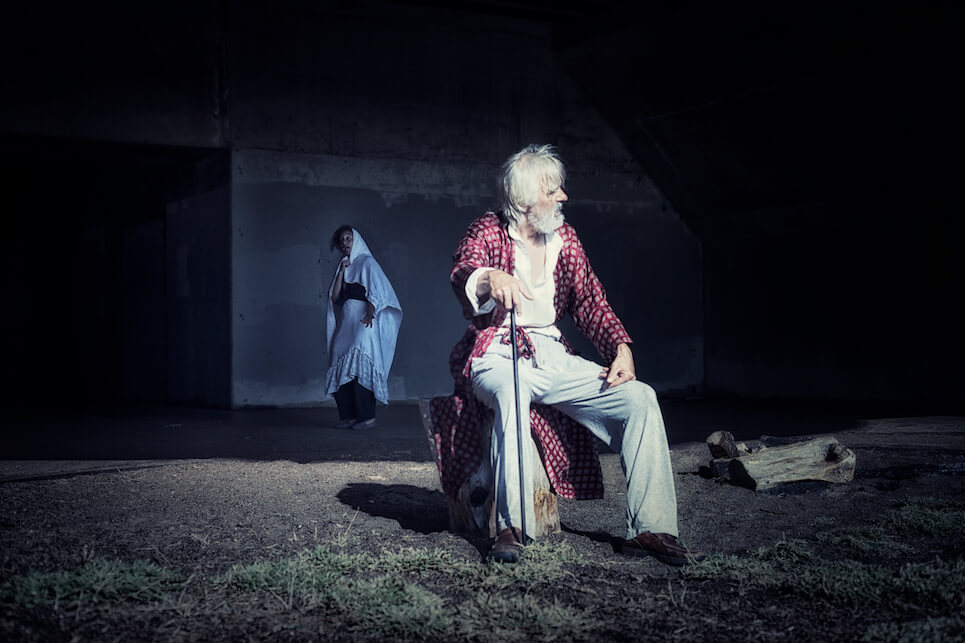
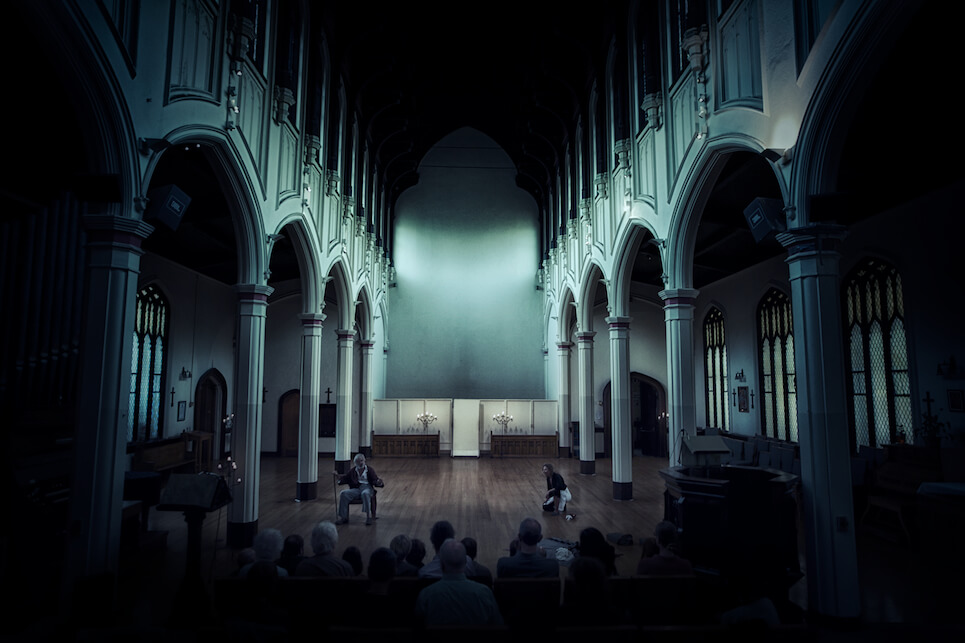
Battery Wallace, the decommissioned coastal artillery in the Marin Headlands, concrete and wind and the Pacific working as uncredited co-author. Uncredited and unpaid, which is how the Pacific likes it. A board member's wild backyard in San Anselmo, where the play about a man losing his home was performed under somebody's oak trees, which is a kind of architectural prayer if you think about it long enough, and look, you should think about it long enough. And the Episcopal Church of St. John the Evangelist in the Mission, a church built to house a particular theory of the universe, hosting a play about that theory falling apart. Falling apart, in a church, on a Sunday. You think the building knew what was coming? I think the building knew.
No single audience saw all three. They couldn't have. The sites required different audiences, different walks, different reasons for showing up, different ideas about what they were doing with their evening. So the only person who saw the whole thing (outside of the production), the whole shape of it, across the summer, across the three rooms, across what was probably a hundred separate emotional weather systems in the company alone, was the camera. Me with the camera. The camera with me. Whatever. Same fucking difference.
Which is what these photographs are. They're the through-line the audience didn't get to have. The audience got a single evening. My camera got the summer.
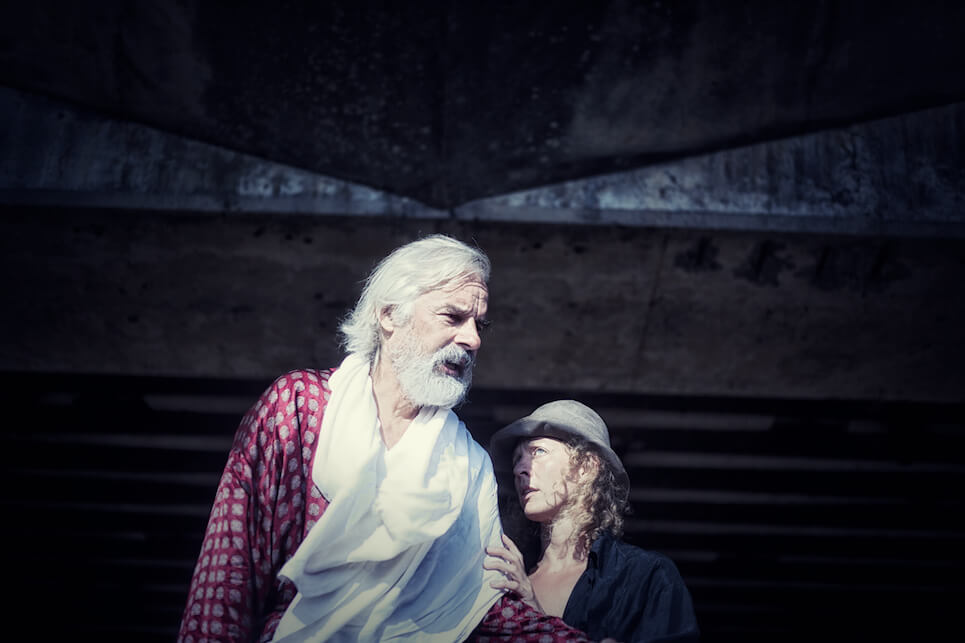
The Battery Wallace images, I can feel the wind in them even now. Even now. Twelve years later. Twelve years. That weird gray Marin light that's neither morning nor afternoon, the kind of light that makes faces look like they're being remembered rather than seen, which is exactly what's happening now, so the light was apparently prophetic, which is the kind of sentence I would have crossed out five years ago and now I'm leaving in. John's white hair against the concrete. Ava's hands. (Ava's hands. That's a whole sentence. That's the whole essay, almost. Ava's hands.) The way the architecture refuses to be a set, refuses to be ambient, refuses to be anything but exactly what it is: a place built by people who imagined a war and prepared for it and then the war never came in the form they prepared for, and now the concrete is just there, waiting for whatever wants to use it next, which turned out to be Shakespeare. Which is funny if you think about it. Which is funny even if you don't. The military planners did not anticipate Shakespeare. The military planners did not anticipate a lot of things.
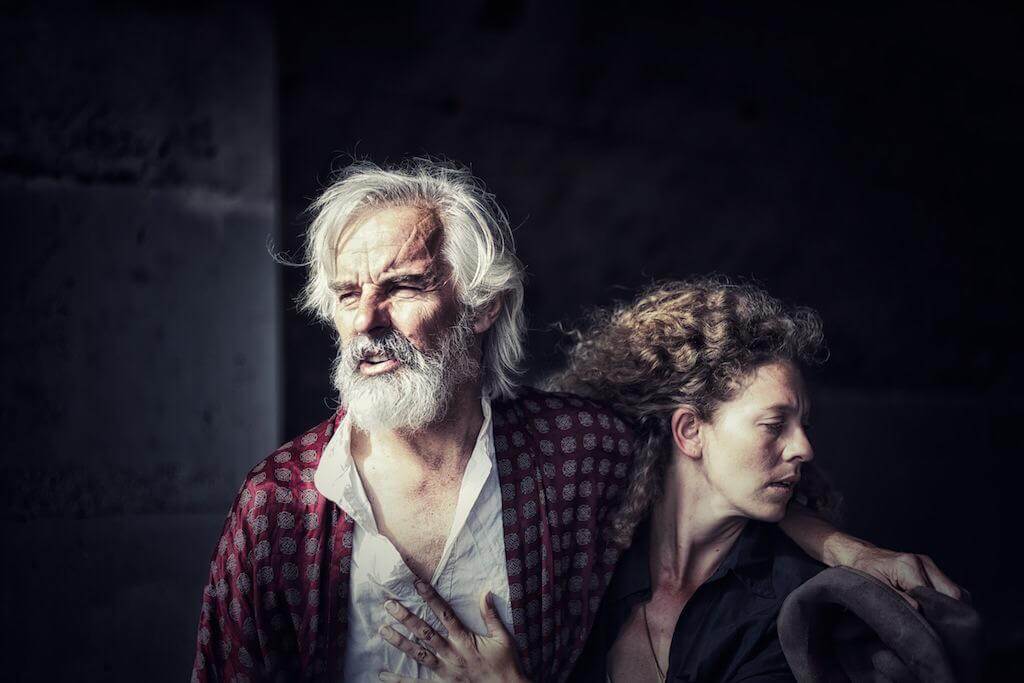
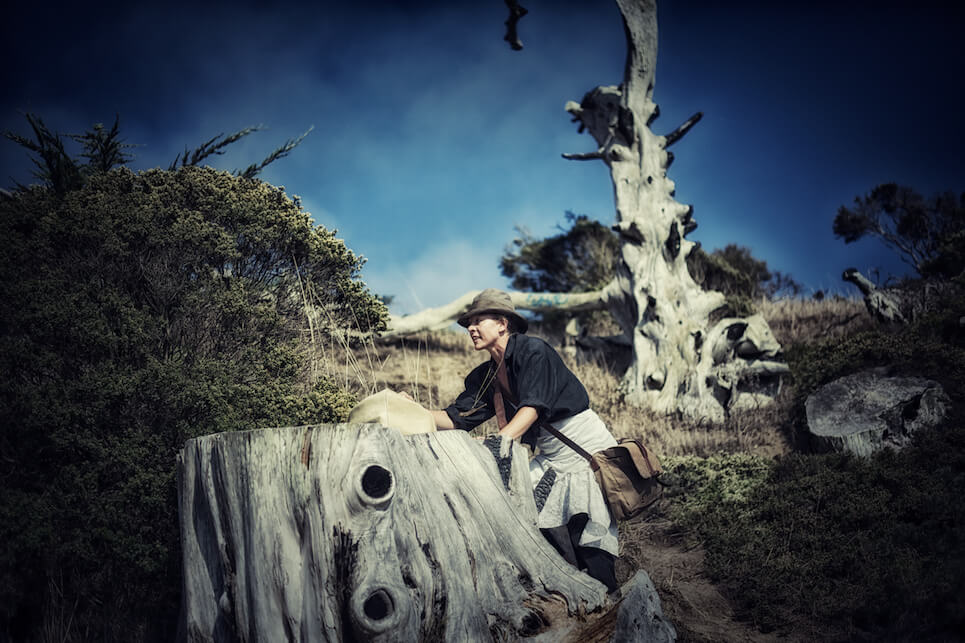
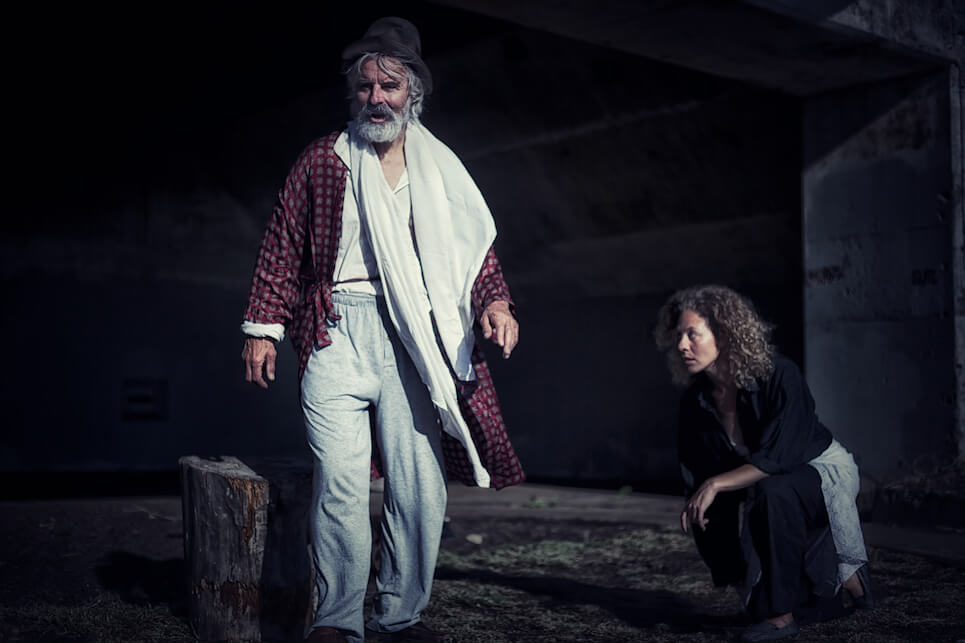
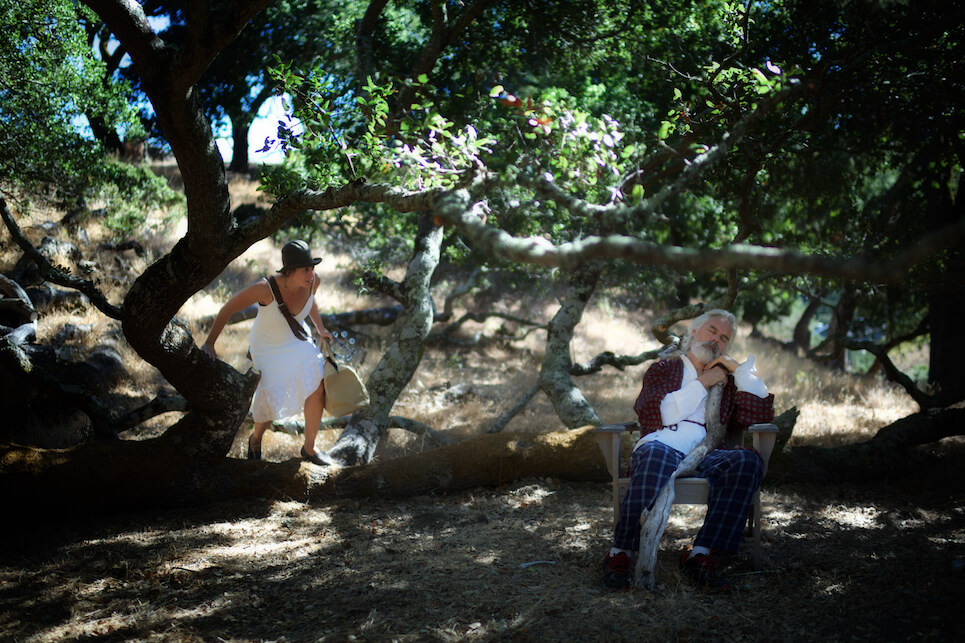
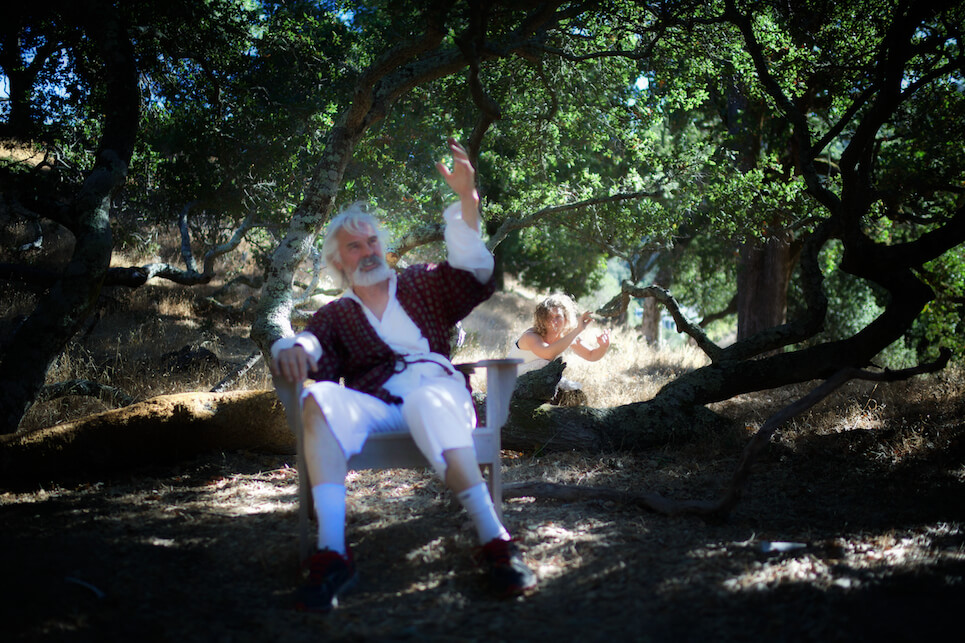
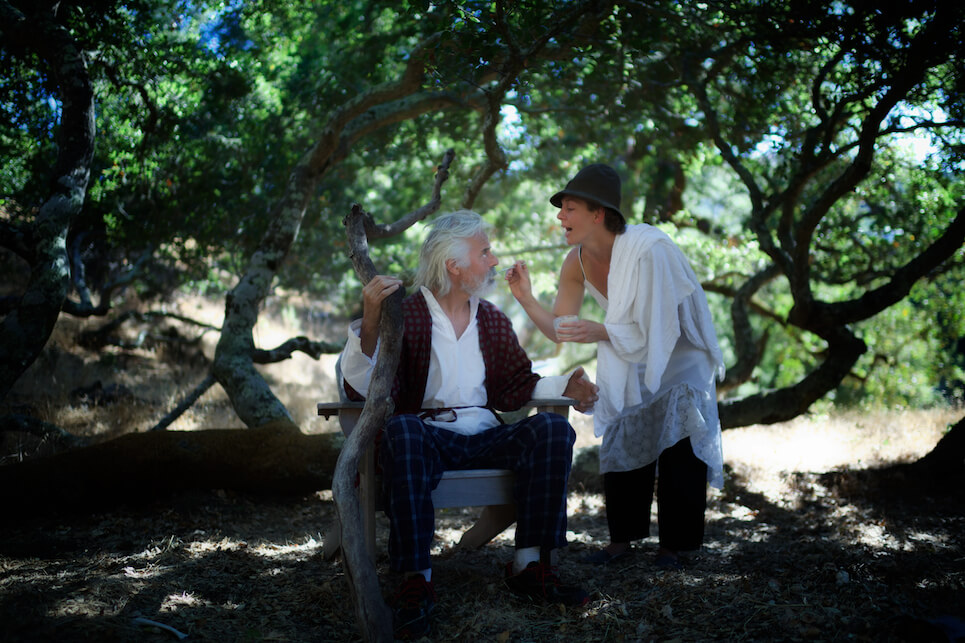
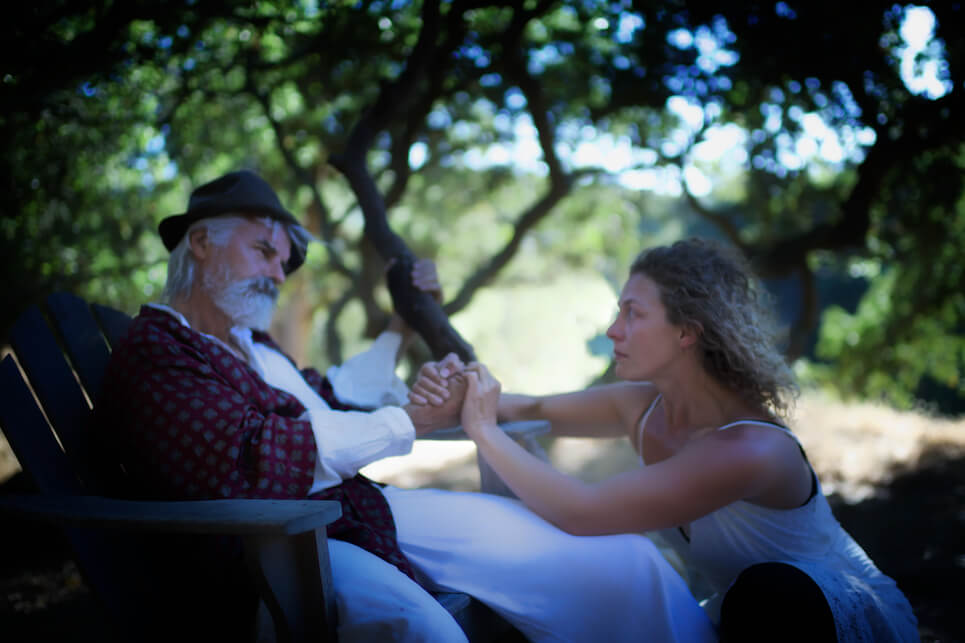
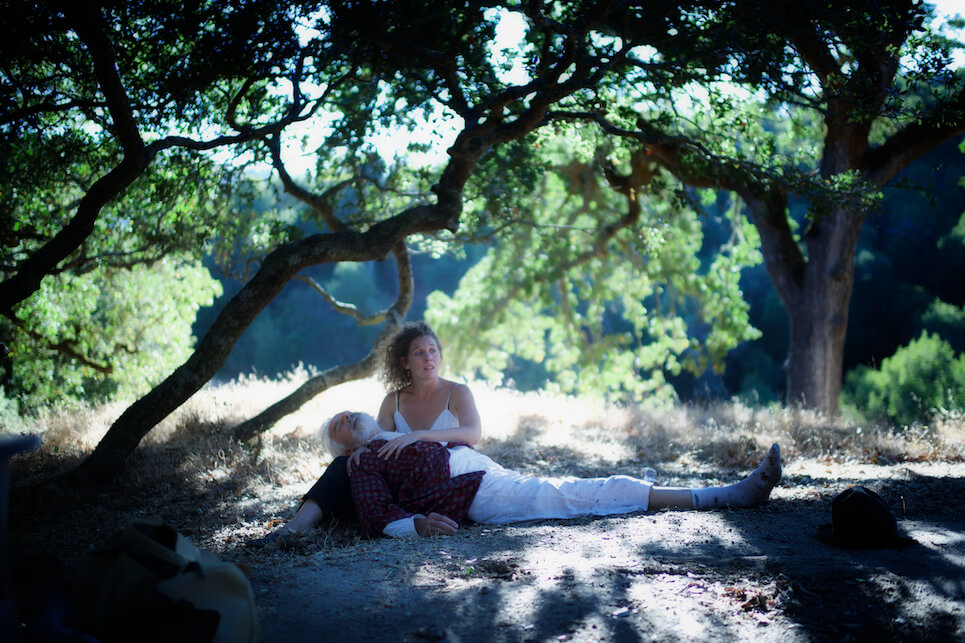
The San Anselmo images are different. Different light. Different scale. Different conditions, entirely different conditions. San Anselmo in late summer is brutal, the kind of inland-Marin heat that makes a coastal Californian remember that California is mostly a desert wearing a fog hat, and the desert was in full effect that summer, the fog hat got left at home. The play happened in a board member's backyard, the kind of wild Marin backyard that hasn't been landscaped so much as negotiated with, ivy and oak and overgrown grass and, I'm not making this up, a swimming pool somebody had been generous enough to put right there in the middle of it. We took advantage. Of course we took advantage. Skinny-dipping between calls, between the kind of calls that leave everybody sweating through their costumes anyway, so what's the difference, who's keeping score, who's even watching, the play is about a kingdom collapsing, our clothes are the least of it. A backyard is its own kind of charged space. Not domestic the way a living room is domestic. Different. Inhabited is the word. Somebody's actual yard, somebody's actual oak tree, somebody's actual fence the neighbor's dog is barking from, on cue, every time, because dogs are the great uncredited collaborators of outdoor theater and we should thank them more. To stage Lear in a backyard is to import the play's cosmic register into a space that's already half-civilized and half-not, half-built and half-grown, exactly the kind of in-between space where a play about a kingdom falling apart belongs. I hope the photographs catch that. They have to. There's nowhere else for the meaning to go. The way Ava and John are too close to the audience. The way the wild edges of the landscaping become the wild edges of the heath. The way the light, by the third act, has gone the color of an apricot somebody left on the counter too long. (Yes, an apricot. That kind of evening.) There's a frame from one of those evenings I still can't decide whether it's a still from the play or just a picture of people sitting too close together in a yard at the end of a hot day. Maybe both. Probably both. Definitely both.
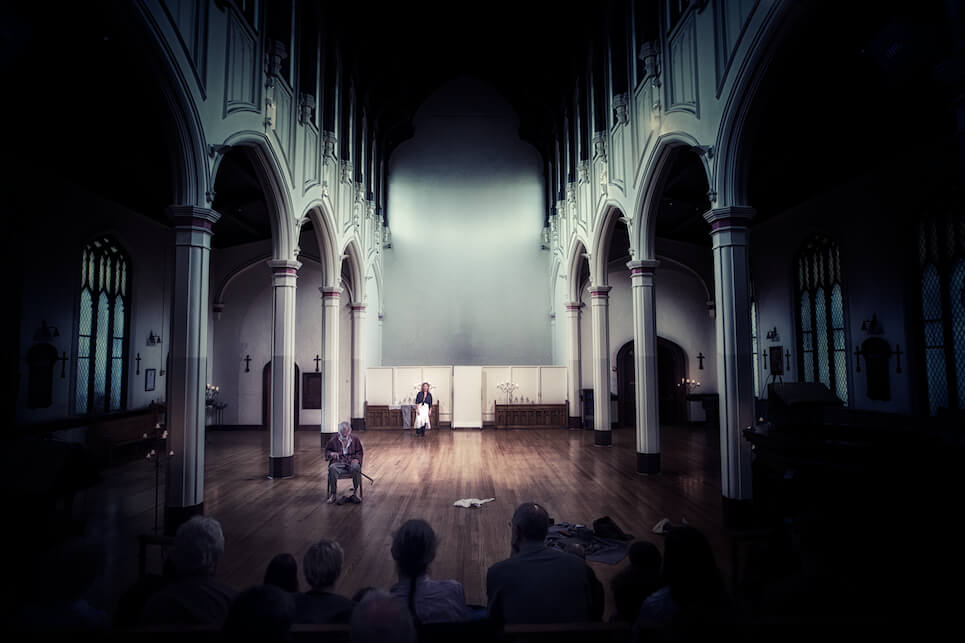
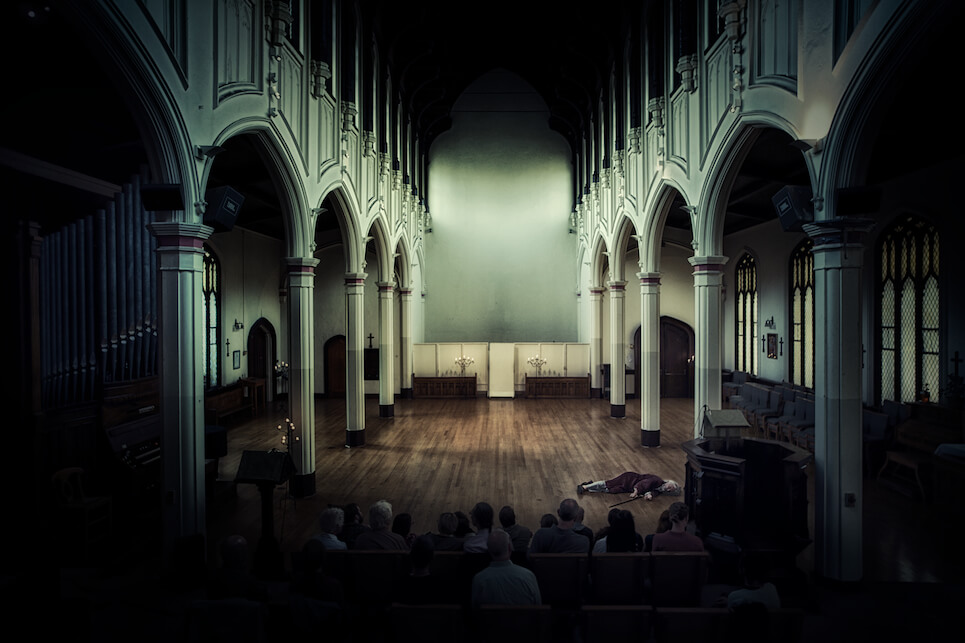
And the church. The church. The church is the one I had to think hardest about while shooting, because a church is already designed to be photographed in a particular way, the long sightlines down the nave, the light through the windows, the architecture telling you, with the full institutional weight of two thousand years of Christian aesthetics, where to stand. It's a beautiful church, I'm sure god approves. But a photographer in a church is constantly fighting the church's own opinion about how it should be seen. Which the church will, by the way, win, if you let it. After all, it's got god on its side. So you don't let it. You find the angles the church doesn't expect. The actors against the altar, the actors against the stations of the cross, the actors at floor level when the church wants you to be looking up, the actors making the building uncomfortable because the building has been comfortable for too long. The photographs from St. John's are the ones where I felt most like I was negotiating with the room itself. The room had opinions. I had a camera. God and I compromised.
There was a fourth site. Bernal Hill. I'm not including it. Bad site, bad audience, bad vibes, although honestly read that list backwards, the vibes did most of the work. The hill didn't want the play, the audience didn't want to be there or more accurately were there for the wrong reasons, the vibes were the vibes you get when a hill and an audience don't want a play, which is to say bad. Some nights you photograph. Some nights you put the camera down and remember that you have other things to do with your life. That was a put-the-camera-down night. Moving on.
Across all three sites, the same two faces. John and Ava. The same two faces in three sites. Same people, same play, three different physics. Watch what happens to those faces across the gallery, actually watch, don't just scroll. Battery Wallace makes them weather. The backyard makes them family. The church makes them figures from a story that's been told for a long time. Same faces. Three meanings. The faces didn't change. The places changed what the faces meant.
The light's gone now, of course. The runs are long over. The Mission is not the Mission it was in 2014. (The Mission is barely the Mission anymore, period, but that's a different essay, a longer one, an angrier one, you don't want me to write that one.) The Headlands are still the Headlands, but the staging is gone and the wind doesn't remember. The wind never remembers. That's actually one of the features of wind. The photographs are what's left. The photographs are the only place the three productions ever met.
Which is part of why a photographer takes the picture in the first place. Not so the audience that night can have a memento, though that's a kindness, it's a real kindness, don't underrate it. Not so the production can have publicity, though that pays the bills, and the bills, last I checked, still get paid. You take the picture because in five years, ten years, twelve years, somebody is going to want to know what the place or production or actor actually looked like when the work was happening, and the only honest answer to that question is the photograph. The honest answer. The only honest answer. The photograph is the production remembering itself.
These are the productions remembering themselves.
Eventually the work passed to somebody else. That's how it goes. That's always how it goes. The photographer changes, the company keeps going, the wind blows through everything regardless. The handoff happened on a bocce ball court in Sausalito, on a sunny afternoon, with wine, which is the perfect setting for any number of things and not the perfect setting for any of them. I was playing bocce with John and two strangers we'd been charming for free drinks for the better part of an hour, because charming strangers for free drinks on a Sausalito afternoon is what two broke artists do, it's part of the deal, it's how we like to spend our time. A bocce ball court. A bocce ball court in Sausalito. You can't write this. You can't. Then Ava arrived. Ava arrived, and Ava introduced me to the woman who would be taking the pictures from now on. She also asked me, in roughly the same breath, roughly the same breath, if I would help her learn how to do it. I said yes. Of course I said yes. What was I going to say? I had a glass of free wine in my hand and John right there pretending he wasn't watching and two strangers who had no idea what was happening but could probably tell something was. You don't say no to that ask, you don't say no on a bocce court in Sausalito in the afternoon with free wine and your friend doing his best not to make a face, you don't say no to somebody you love. You just don't. So I helped. I helped, I taught, I showed, I did the thing. She took pictures that looked… familiar, to be polite, which is the compliment that isn't one. (Read that twice. The compliment that isn't one.) I also took her portrait for the company website. The website I had built. The website I had built. You can't make this shit up, you cannot, I have tried, my imagination is not this cruel.
The portrait was taken on the shore. The literal shore, at the edge of the literal water, which is a metaphor so heavy-handed that no writer would dare use it on purpose, but life will use it on you whether you consent or not. That photograph, the last one I ever took for the company, is still on the website. Hell, it's a good photograph. Same shore. Same smile. Same edge. Some sites remember themselves more than once. Some sites remember themselves in somebody else's voice. And some sites, some sites, get to watch you teach the next voice how to…
Have more than thou showest, Speak less than thou knowest, Lend less than thou owest, Ride more than thou goest, Learn more than thou trowest, Set less than thou throwest; Leave thy drink and thy whore, And keep in-a-door, And thou shall have more Than two tens to a score.William Shakespeare · King Lear, 1.4