There's this moment, you know the one, when the dock lines fall away and everything solid becomes memory. That's when Rocinante becomes something closer to theology. She's named after a broken down nag that carried a madman toward impossible windmills, which tells you everything about intention and nothing about outcome.
She doesn't apologize for what she is. There's no chrome fetish here, no teak and brass pornography for the yacht club set. Rocinante is honest in the way old guitars are honest, scarred and functional, every ding a sentence in an ongoing autobiography written in salt and weather. The gelcoat's crazed like a roadmap she earned. Some previous owner raced her Trans Pac, pushed her hard across 2,225 miles of open Pacific. Another took her around the entire goddamn world. She's got ocean in her bones that I'll never fully know, passages and landfalls I inherited like family stories, half legend and completely true.
What she offers instead of perfection is this: a platform for becoming someone else. Or maybe for becoming who I actually am when nobody's keeping score. I've done three runs out to the Farallons and back, those granite fangs jutting from the ocean 27 miles west of the Golden Gate. That's my kind of pilgrimage. Far enough that the city disappears, close enough that I'm not committing to crossing an ocean. Yet. Two weeks down to Monterey and back, learning her rhythms and mine, figuring out what we're capable of together.
Maybe one day we'll go farther. That's the promise that hums in the rigging.
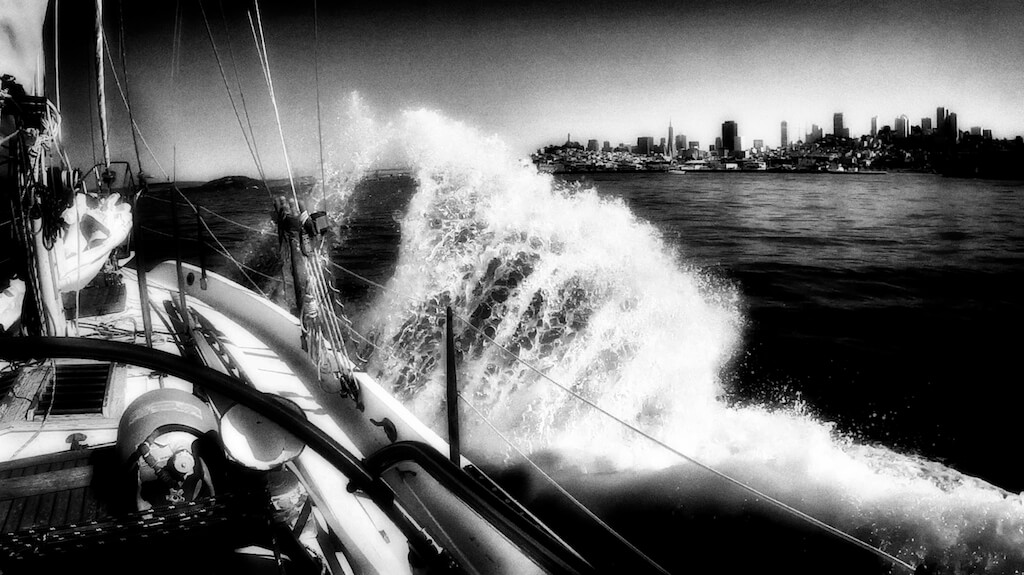
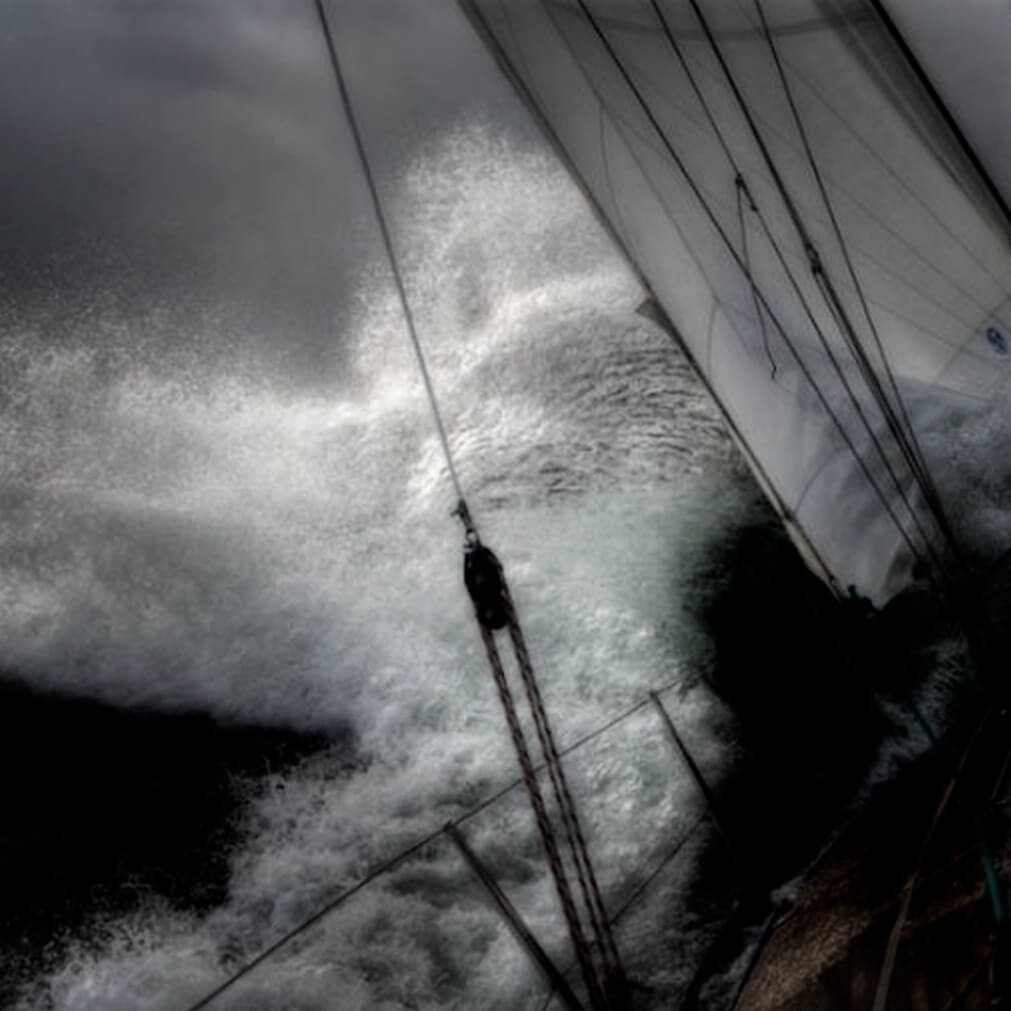
Rocinante teaches through discomfort and revelation. She demands I learn her particulars: the way she hobby horses in a chop, the exact angle where she balances perfectly on a close reach and damn near sails herself. You develop a physical vocabulary, the muscle memory of cranking a halyard, the precise pressure on the tiller in heavy weather, the sound the rigging makes when it's content versus when it's screaming warnings I'd better heed.
The thing about inheriting a boat with history is I'm never sailing alone. Those previous owners, the ones who pushed her through the Transpac fleet or navigated her through the Indian Ocean, they're there in every fitting they chose, every repair they improvised at sea. I'm just the current custodian of something that's already proved itself under conditions I've only read about. She's been tested. I'm still taking the entrance exam.
Living aboard, even briefly, recalibrates your sense of necessity. I discover most of what I thought I needed was elaborate insulation from being alive. Four walls, climate control, endless distraction, all designed to keep me from noticing that existence is fundamentally raw and uncertain and absolutely fucking magnificent. Rocinante strips that away. I get weather, motion, the specific quality of light at dawn when the Farallons emerge from fog like they're being conjured.
She's not a metaphor. She's the actual thing: wood and metal and fabric transforming wind into motion through principles humans figured out before they invented writing. Ancient and immediate. Every passage is simultaneously primal and technical, demanding both instinct and calculation.
The adventures accumulate. Three trips circling those jagged islands where the white sharks hunt and the seabirds wheel in their thousands. Two weeks exploring the stunning crescent of Monterey Bay, anchoring in coves, learning what it means to be genuinely self sufficient. Each voyage writes itself into her fabric and into mine. I carry her forward and she carries me.
This is the deal: Rocinante promises nothing except the opportunity to be fully present in my own life, to trade comfort for intensity. She's already been around the world. Maybe we'll get there again together, or maybe we won't. Either way, she delivers every single time.